Hugging Face
The short verdict
For builders, not for users: this is the open-model ecosystem's library, catalogue and delivery counter, worth daily use the moment you need a model inside your own thing — and worth nothing if you only wanted to talk to one. The paid tiers buy convenience; the licence field on each model card is the real bill, and it's the paragraph that bites you later. If what you're shipping touches the open-model world, this is home base; if what you want is an assistant, buy an assistant.
- Maker
- Hugging Face
- Category
- Research
- Entry price
- Freemium
- Free option
- Yes — the hub, datasets and most public models are free; compute and hosted inference are usage-based
- Works on
- Web hub; Python and JavaScript libraries; CLI; hosted Spaces, datasets and inference endpoints
- Pricing checked
- October 2026
What Hugging Face is, plainly
Hugging Face is not an app you use; it's the place the open-model world keeps its things. Hundreds of thousands of model repositories, datasets and hosted demos, plus the libraries — transformers and its neighbours — that became the de facto plumbing for loading and running that ecosystem from Python. If you're a developer or researcher, it occupies the position GitHub occupies for code, with the crucial difference that what's hosted here is weights and data, and what you take from it carries a licence whose terms you actually have to read.
For builders, the practical value ladder runs from free to committed. At the bottom: read model cards, download weights, run locally or on your own GPU, prototype in Spaces with a hosted notebook — all effectively free, with modest included compute. In the middle: PRO and Team plans grant hub conveniences, private repos with governance controls, and small credit allowances, while serious hosted usage is billed hourly per GPU instance, by hardware type, on the vendor's own infrastructure or your cloud account. At the top: Enterprise adds SSO, auditing and compliance postures. The important distinction is that the paid tiers buy platform convenience and governance; the models themselves are generally free to pull — which makes the licensing paragraph below, not the pricing paragraph, the one that can hurt you.
This entry has to be written for a different reader than the rest of the directory because the tool is infrastructure: the right test of Hugging Face isn't 'does the output impress me' but 'can I ship something that depends on it'. For that audience the genuine competitive strengths are range — when a new open model matters, it's here within days, often with weights, dataset and demo beside it — and neutrality. The genuine weaknesses are the ones consumer-tool profiles never mention: a hub of that size contains junk, stale projects and misleading model cards; discovery requires actual judgement; open-model quality gaps against the frontier closed assistants mean you're often assembling what a ChatGPT subscription would give you in one click — except yours runs on your terms, your data path and your cost curve. The honest 80% rule: if what you want is to use an assistant, subscribe; if what you want is a model inside your product, your privacy boundary, or your fine-tune pipeline, this is the starting map.
Which brings the licence question front and centre, because the site will not shout it at you. 'Open on the hub' means public weights, not public rights: every model card carries its own terms, ranging from permissive Apache-style licences through use-restriction licences that forbid certain applications, through historically-restricted research-only weights, and some licences impose their own acceptable-use and output-terms obligations on you as the deployer. The hub doesn't police this and your use of a model doesn't launder it through a third party. Reading the licence field of the model card, before download and before product integration, is the ten minutes that separates this ecosystem's promise from its litigation exposure. Fine-tuning and merging don't reset the clock either — derivative weights generally inherit the original terms.
Where it wins
- Where open models land first: weights, dataset, demo, and community issues in one place, usually within days of release.
- The default toolchain (transformers plus the hub APIs) is the de facto standard, which means documentation, examples and hiring all exist.
- Free is genuinely substantial — the core of the platform costs nothing, and modest compute allowances cover serious experimentation.
- Self-hosting open weights gives you a privacy, cost and data-control path that no closed-API subscription can match.
- Model cards, dataset sheets and Spaces-as-eval give builders unusually well-attached provenance for how a model was made.
Where it falls short
- Licences vary per model and several restrict usage — 'it's on the hub' is not 'I can ship it', and neither the hub nor a fine-tune absolves you of reading terms.
- Discovery is uncurated at scale: stale repos, misleading claims and near-duplicate weights are part of the ecosystem's texture.
- Quality of the open tier trails frontier closed assistants, so you often spend integration hours to approximate a twenty-dollar-a-month subscription.
- Compute billing under real traffic is where a hobby prototype becomes a CFO conversation — cost modelling is per-workload, per-accelerator, and your responsibility.
What it's built for
The model hub
Search, compare and pull weights across every task type — text, vision, audio, multimodal. The canonical first stop for any open model release, with the release's own card and licence attached. Its scale is the discovery problem: curation is on you.
Datasets and evaluation listings
The training corpus of the open world sits here with viewers and metadata. For researchers it's the working inventory; for builders it's the honest way to test a candidate model against your own eval before deciding anything.
Spaces and demos
Hosted Gradio/Streamlit apps attached to models, usually runnable free with limited GPU quotas. The best way in the category to try an architecture's real behaviour — not its marketing video — and to ship your own demos without servers.
Inference providers and endpoints
Serverless per-token access to open models or dedicated per-GPU-hour deployments, with autoscaling and VPC options for production. The pragmatic middle path between 'download the weights' and 'buy a closed-API contract'.
Private and enterprise repos
Gated repos, org permissions, audit logs and resource groups under paid plans — the governance layer companies need before pointing this ecosystem at real product data.
What it costs at your team size
| Plan | Indicative price | What you actually get |
|---|---|---|
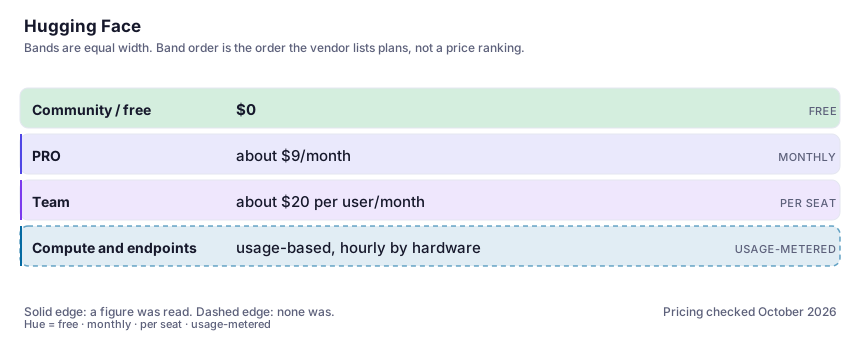
| Community / free | $0 | Everything the open ecosystem is for: public repos, datasets, Spaces, downloads, and modest included ZeroGPU-style compute. Most of the value of the platform is on this tier and costs nothing. |
| PRO | about $9/month | Higher hub limits for active individuals — storage, private-repo scale, some inference credits and compute perks. Buy it as an individual when the free limits actually pinch, not pre-emptively; it reads from the vendor's pricing page at writing time and these allowances move. |
| Team | about $20 per user/month | Org governance: SSO, resource groups, audit logs and centralised token management. This is the first tier that makes sense as a company line item. |
| Compute and endpoints | usage-based, hourly by hardware | GPU deployments billed per instance-hour at rates from a few cents up to many dollars depending on accelerator; serverless inference billed per token or by request volume. The vendor's pricing pages list the live numbers — model them per workload, because this line swamps subscription cost under real traffic. |
Count the people who would each need their own login.
Who it fits, and who it doesn't
Reach for Hugging Face if you…
- Developers who need a model inside their own product, with the privacy and cost control that self-hosting buys.
- Researchers and tinkerers evaluating the open-model frontier weekly — fine-tuning, benchmarking against their own evals, reading actual weights.
- Teams standardising internal ML infrastructure: private repos, gated datasets, org-level access management.
- Anyone who wants to run something a closed API won't run — local assistant models, offline tools, domain-specific small models.
Skip it if you…
- You want an assistant, not a model: a closed chat subscription is the 80% path with zero integration cost — this is infrastructure, not a product you open in the morning.
- You cannot audit a model card's licence for each component you ship — a commercial API with indemnity-style terms is the lower-risk wrapper for the same capability.
- You have no compute plan and no appetite for per-hour billing; the free experimentation tiers will hit their ceiling and the rest is procurement.
How to test it properly in 30 minutes
Don't judge a tool on the demo. Run the same four tasks you'd actually do with it, and score it against this checklist — the same one this desk works from before a profile goes up (see how we check a tool).
- Pick two candidate models for one task you actually have; run both against a small private eval set of your own examples — not a leaderboard. That comparison is the platform's core workflow.
- For each candidate, read the model card's licence and restrictions fields end to end and note precisely what you would owe in a product: attribution, use limits, redistribution rules.
- Prototype one pipeline through the standard libraries to confirm the integration cost you'd be accepting versus a closed API contract.
- Estimate real monthly usage and price it on the endpoint/inference page with your own hardware choice. Model the number before the demo, not after.
- Check the dataset card for anything you plan to train on, and verify provenance claims before they enter a product pipeline.
Alternatives worth comparing
An answer engine that cites its sources — the tool to open when you need to check, not just to write.
The default AI assistant — the broadest feature set, and the benchmark every other tool gets measured against.
The image model you run yourself: unlimited private generations and real control, paid for in setup time and hardware.
Disclosure: this profile is editorial. Hugging Face did not review it, pay for it or provide a free account for it. Links to the vendor are plain outbound links, not affiliate links. Errors are mine — report one and it gets fixed and logged on the updates page.