Stable Diffusion
The short verdict
The only image tool that gives you real control and no meter, and the only one whose cost is mostly effort. Buy it with hours, not money: if nobody on your team will own the install, it becomes an abandoned folder of checkpoints. If someone will, it does things the subscription tools cannot — repeatable identity, structure conditioning, private volume — for free below the vendor's stated revenue threshold.
- Maker
- Stability AI
- Category
- Image
- Entry price
- Free to run locally; optional hosted credits and API
- Free option
- Yes — the weights are free to download and run
- Works on
- Windows, macOS, Linux on your own GPU; hosted web playground and API
- Pricing checked
- October 2026
What Stable Diffusion is, plainly
Stable Diffusion is not one product. It is an open-weights model family from Stability AI plus the ecosystem that grew around it — interfaces like ComfyUI and AUTOMATIC1111-style web UIs, thousands of community fine-tunes, and add-on modules that condition generation on a pose sketch, a depth map or a layout. That ecosystem is the reason it survives as a serious option in a market where the paid tools have gotten much better. Nothing here phones home, nothing meters you per image, nobody's content filter decides your brief is ambiguous, and the image you make on a Friday at 2am is not in anybody's gallery.
The capabilities that justify the setup are control and reproducibility. With pose and structure conditioning you can dictate where things sit in frame instead of negotiating with a model. With a LoRA trained on twenty of your own photos you can get the thing no subscription tool gives you reliably: the same character, the same product, the same illustration style, across hundreds of images. With inpainting, outpainting and tile-based upscaling you can fix one region, extend one canvas or take one frame to print size. This is also the only mainstream route where the whole pipeline can run air-gapped, which matters for regulated or client-confidential work.
The costs are real and mostly not financial. You need a discrete GPU with serious video memory; an office laptop will not do it, and the recent model generations are hungrier than the older ones everyone's tutorials used. Setup is an ongoing chore — driver updates break things, a node graph from a YouTube video does not match the current interface, and community checkpoints get pulled and reposted. Quality equals whatever the checkpoint you picked was trained on, and many popular ones were trained on copyrighted work without recorded consent, so you inherit an unclear provenance trail with every output. Text rendering is poor on the older models and better-but-still-flaky on the newer ones; long strings and small print remain unreliable. On licensing, the vendor's own terms are the good part: researchers, hobbyists, students and small businesses can use the models at no cost, and a paid enterprise licence is required only above a stated annual revenue threshold of USD $1M — a figure we read from Stability's licence page rather than guessed. Anything above that, or embedded in a product you sell, needs a commercial agreement. What the licence does not solve is copyright in your output, or the risk that a fine-tune's training data included a living artist's work; the model card tells you the base, not the inputs of the community version you downloaded.
Where it wins
- No meter and no queue: run four thousand images overnight and nobody invoices you.
- Real control — structure conditioning and LoRAs give repeatability the subscription tools still fake.
- Private by construction; nothing about your brief leaves your machine.
- The licence is unusually friendly for small teams: free below the vendor's stated revenue threshold.
- You can pick, patch and roll back models instead of accepting whatever a hosted product swapped in this month.
Where it falls short
- Hardware and upkeep are the price. Drivers, versions and broken community UIs are part of the job.
- Provenance is opaque: most popular checkpoints were fine-tuned on unrecorded datasets, so outputs inherit that ambiguity.
- Quality is a function of your model-picking skill; the base release alone looks ordinary next to a paid tool.
- Text rendering, hands and physics still fail more often than in the closed tools at the same effort level.
- No guardrails means you are the compliance department — for content, for licensing, and for what you publish.
What it's built for
Run it locally, forever, for no per-image cost
Download the weights, load them into an interface, generate. No credit counter, no queue, no usage policy review, no one seeing what you make. The unit of cost becomes your electricity and your time.
LoRA fine-tuning for repeatable identity
Train a small adapter on your own character, product or art style and reuse it in every batch. This is the single capability that paid tools still cannot match for consistency, and it is why studios keep one person who knows how to do it.
Structure conditioning with ControlNet
Feed it an edge map, a pose skeleton or a rough layout and the output obeys it. Turn a sketch into a rendering, or block a composition exactly and let the model handle texture. Nothing else in this category lets you dictate geometry this directly.
Inpaint, outpaint and upscale with your own models
Fix one region, expand a canvas in a chosen direction, then take the result past its native resolution with a separate upscaler. Because it is file-based, you can chain a hundred steps and revisit the good ones — the opposite of a chat window.
A node-graph workflow (ComfyUI)
Workflows save as files, run headless, and can be versioned and shared. It looks like a mistake from a screenshot and feels like engineering once you have built one you depend on. Steep start; the reason serious users live here.
Hosted playground and API if you would rather not install anything
Stability sells credit-based hosted generation and an API. Convenient, but you are back to a meter and to a provider's content policy — which is what you installed locally to escape.
What it costs, and what these numbers cannot tell you
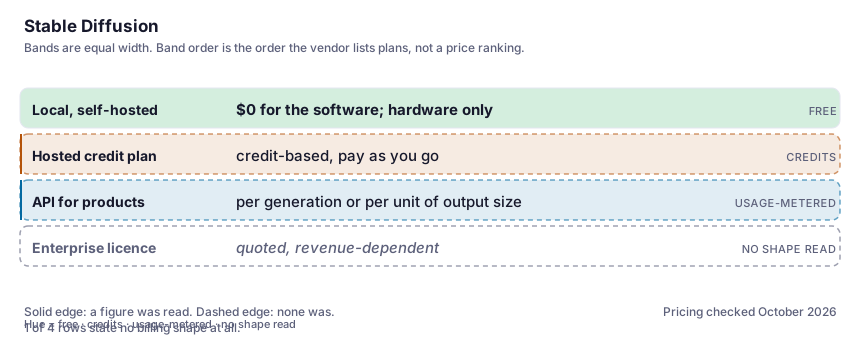
| Plan | Indicative price | What you actually get |
|---|---|---|
| Local, self-hosted | $0 for the software; hardware only | The default answer. Free under the Community License for individuals and organisations under the vendor's stated USD $1M annual revenue threshold. Your real costs are a capable GPU, disk space for checkpoints, and the hours you spend keeping the install working. |
| Hosted credit plan | credit-based, pay as you go | Stability sells credits for its web playground and API. We did not verify current per-image rates for this build, and they move — read the vendor pricing page before budgeting. Judge credits per image at the resolution you actually use, not per "generation". |
| API for products | per generation or per unit of output size | The pragmatic path when you want the model's flexibility without users touching your GPU. Price your own expected volume first; a credit table designed for occasional design work is a bad fit for high-volume automation. |
| Enterprise licence | quoted, revenue-dependent | Required above the vendor's stated annual revenue threshold, and the route to take if you embed the model in something you sell or need support and contract terms. Get the threshold confirmed in writing for your situation. |
Who it fits, and who it doesn't
Reach for Stable Diffusion if you…
- Anyone needing the same character, product or art style across a large volume of images.
- Regulated, confidential or embargoed work where the prompt must not reach a third party.
- High-volume pipelines where a per-image credit cost would dominate the budget.
- Technical users who want structure conditioning, inpainting and custom fine-tunes as first-class tools.
- Small studios under the vendor's revenue threshold that want zero-marginal-cost generation.
Skip it if you…
- You do not have a machine with a discrete GPU and don't want to buy one — a hosted tool is cheaper.
- You want a striking image from five words with no technical interest; the aesthetic-first tools do that better.
- Someone non-technical needs to keep it running after you set it up.
- You cannot own the licensing question yourself and need a vendor to warrant the training data.
How to test it properly in 30 minutes
Don't judge a tool on the demo. Run the same four tasks you'd actually do with it, and score it against this checklist — the same one this desk works from before a profile goes up (see how we check a tool).
- Check your GPU's video memory against the model you intend to use before installing anything, then time ten generations. Speed, not capability, is what usually kills a local setup.
- Train a small LoRA on twenty images of one thing that is yours — a product, a character, a style — and generate ten images with it. This single test shows you what the whole category cannot do.
- Run one structure-conditioned job: give it a pose or layout sketch and see whether the output obeys the geometry.
- Ask for a sign with two sentences of text and inspect at full size. Confirm the text ceiling for your chosen checkpoint.
- Upscale one frame to your real print or hero-banner size and look at it on a large monitor. Count the artefacts before you commit to a deliverable.
- Read the specific model's licence and the community checkpoint's own notes — the base licence and the fine-tune's terms are not the same document.
Alternatives worth comparing
For mood boards, concept art and illustration: the best aesthetic defaults in the category, the least control over exact composition.
Image generation that lives inside your chat: good at following a fussy written brief, average at making it look beautiful.
The hub where open models, datasets and demos live — infrastructure for builders and researchers, not a consumer chatbot.
AI built into Canva — on-brand graphics, decks and quick edits for non-designers who already make their visuals there.
Disclosure: this profile is editorial. Stable Diffusion did not review it, pay for it or provide a free account for it. Links to the vendor are plain outbound links, not affiliate links. Errors are mine — report one and it gets fixed and logged on the updates page.