Elicit
The short verdict
The one research assistant here with a real workflow behind it: if you are screening literature under a protocol and need the log to survive review, Elicit earns its per-seat price and nothing else on this list does the job. If you want understanding rather than extraction, the free tier plus a general assistant covers most of it. Buy the plan your volume needs against the published paper ceilings, and never treat the vendor's accuracy percentages — which disagree across its own pages — as a substitute for checking the quotes.
- Maker
- Elicit / Spark AI
- Category
- Research & study
- Entry price
- Freemium
- Free option
- Yes — unlimited paper search and unlimited summaries, with the Research Agent and Reports capped at 'limited usage'
- Works on
- Web app; API access on paid tiers; import from Zotero
- Pricing checked
- October 2026
What Elicit is, plainly
Elicit is a research tool shaped like a database query, not like a chat. It searches a corpus the vendor puts at over 138 million items, drawn from Semantic Scholar, OpenAlex, PubMed and ClinicalTrials.gov according to its own help centre, refreshed weekly, with preprints from arXiv, bioRxiv, medRxiv and SSRN included. On top of search it builds the two things that make it worth money: tables that extract a chosen column across hundreds of papers at once, and a systematic-review workflow that proposes inclusion criteria, screens papers against them, and shows the sentence from the abstract behind each decision. That last part is the product's real invention — a log of every decision, override and adjudication, exportable so a PRISMA flow diagram can be reconstructed afterwards. The vendor is also unusually explicit about the boundary: where it has no full text, it works from title and abstract, which matters a great deal for what you should trust.
Against the obvious alternative — a frontier assistant with web search such as Perplexity or ChatGPT — Elicit wins on corpus discipline and loses on breadth and reasoning. It will not help with the policy document, the book chapter, the industry report or the filing outside its indexes, and its own documentation concedes gaps, including in Chinese-language publications. Its report prose is more template-driven than a real assistant's: a good literature brief, a mediocre essay. And if the task is 'find me five relevant papers and tell me what they argue', a general assistant plus Google Scholar is free and reads better. If the task is 'screen 2,000 records against these criteria, extract four fields from every included study, and keep a defensible log', that is a job Elicit is built for and a general assistant is not.
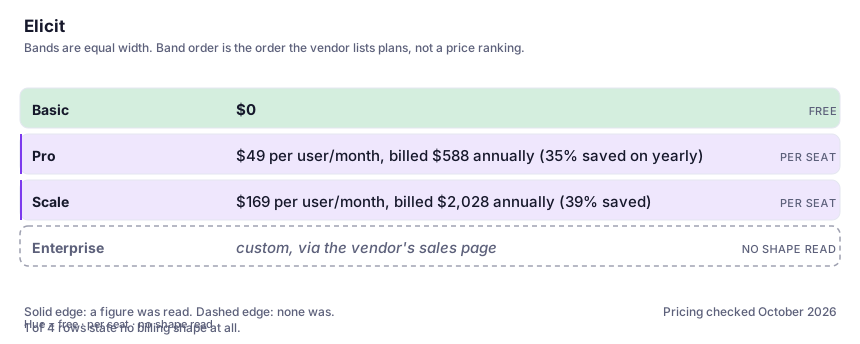
The commercial shape needs reading before paying, because the metering is vague exactly where it hurts. Free Basic is generous where it costs little — unlimited search and summaries — and tight where compute is consumed: 'limited usage' on the Research Agent and Reports, with no figure published for what limited means, so you discover your allowance by hitting it. Pro at $49 per user per month (billed $588 a year, the page says 35% saved) is the systematic-review tier: standard usage, screening up to 5,000 papers, 20 extraction columns at a time, reports over up to 135 data sources. Scale at $169 buys five times the usage, 30 columns, 200 sources, figure interpretation and an admin panel. Enterprise is custom, with 'no training on your data by default', 40,000-paper screening, SSO and single tenancy. Note what the ladder sells: the same capabilities at higher ceilings, plus governance. The surprise is not the subscription but the volume wall in the middle of a review you have already committed to.
Where it wins
- The corpus is named, bounded and documented — you can see which databases it searches and where it admits holes, which is more than most research tools tell you.
- Screening with per-criterion quotes and a logged audit trail is a genuine workflow innovation; the deliverable is a defensible review, not a summary.
- The free tier is usable rather than theatrical: unlimited search and summaries cover occasional literature work indefinitely, with the caps on the expensive features.
- Volume ceilings are published for the review workflow — 5,000 papers on Pro, 40,000 at Enterprise — so a project can be sized against a plan before it starts, and a solo academic can buy a seat without procurement.
Where it falls short
- The vendor's own numbers do not agree across its pages: one solutions page carries a 96% extraction figure, a case study 99.4%, and the researcher count appears as over 5 million, 6.5 million and 7 million in different places. None are independently auditable, so read the academic evaluations instead of the marketing.
- 'Limited', 'standard' and '5x' usage are not quantified publicly, so the agent allowance — the thing you are buying — is discovered by exhausting it mid-project.
- Extraction quality follows abstract quality. Where a field lives only in a table and the paper was not uploaded, the cell still gets filled, and in a 200-row table a wrong cell looks exactly like a right one.
- It is confined to indexed literature and does not remove the reading. Grey literature, books, standards and much non-English work are out of reach, and the adjudication that makes a review defensible costs the same as ever.
What it's built for
Search across a documented corpus
Over 138 million items per the vendor's pricing and help pages, from Semantic Scholar, OpenAlex, PubMed and ClinicalTrials.gov, updated weekly. The page advertises finding up to 1,000 relevant papers and analysing up to 20,000 data points at once — a scale figure, and a hint that one run can eat a month's allowance.
Systematic review screening with an audit trail
It auto-generates screening criteria from your question, which you can agree with, edit or replace; each paper carries per-criterion decisions, exclusion reasons and the abstract quote supporting them; overrides are logged so the review can be reconstructed for PRISMA reporting. No general assistant offers this.
Column extraction over many papers
Ask for a field — population, dose, effect size, limitation — and get a table across the included set, grounded in quotes. Column count and custom extraction from uploaded papers are plan-gated, which is how the tiers differ in practice.
Reports and Routines
Reports produce cited briefs, with the number of data sources they may draw on capped per tier. Routines watch a question and surface new evidence for your review, turning a one-off search into a standing literature watch.
Citations as the unit of trust
Every AI claim carries a sentence-level link to a source. Good discipline, still not proof: the quote has to be checked for whether it actually supports the sentence attached to it.
What it costs at your team size
| Plan | Indicative price | What you actually get |
|---|---|---|
| Basic | $0 | Unlimited search, unlimited summaries, chat with papers it holds full text for, source view and Zotero import. The Research Agent and Reports are limited in usage, with no published number. |
| Pro | $49 per user/month, billed $588 annually (35% saved on yearly) | Standard usage for agent, reports and reviews; screening capped at 5,000 papers; 20 columns per pass; reports over up to 135 sources; Routines, custom extraction from uploads, API access. Read from Elicit's pricing page on 2026-10-07. |
| Scale | $169 per user/month, billed $2,028 annually (39% saved) | Five times Pro's usage, extraction from figures inside papers, 30 columns, up to 200 sources per report, live collaboration, admin panel with usage and seat tracking. Buy it for volume and administration, not a different capability. |
| Enterprise | custom, via the vendor's sales page | 40,000-paper screening, 40 columns, unlimited API access, SSO and SAML, domain verification, custom deployments, and the stated default of no training on your data. If procurement or a data-processing agreement is involved, this is the only tier with the paperwork. |
Count the people who would each need their own login.
Who it fits, and who it doesn't
Reach for Elicit if you…
- Anyone running a systematic or scoping review under a protocol, with inclusion criteria and a PRISMA obligation — the audit trail is the purchase.
- Evidence synthesis in pharma, medtech or academia, where 'who said what, in which study' must be answered with a citation and a date.
- Teams where the extraction table is a shared artefact with several reviewers overruling each other, and the log has to survive scrutiny.
Skip it if you…
- Your sources are books, policy documents, filings or web pages rather than indexed papers — a general assistant with browsing covers that better, on a subscription you likely already have.
- The task is five papers and a paragraph of interpretation; a free assistant plus Google Scholar does it without a meter.
- You need numbers held in study tables and cannot upload full text, since uploads are plan-gated and an unstated agent ceiling is the wrong risk to take onto a deadline.
How to test it properly in 30 minutes
Don't judge a tool on the demo. Run the same four tasks you'd actually do with it, and score it against this checklist — the same one this desk works from before a profile goes up (see how we check a tool).
- Search one question you already know the literature for and check the first twenty results against three papers you know are central. Missing-known-paper rate is a recall test you can run in ten minutes on your own topic.
- Screen a hundred records with your own criteria, then re-screen twenty by hand and count disagreements. Read the abstract quote attached to each decision — that loop is the product, so verify it before a real review depends on it.
- Ask for a column you know appears only in a paper's tables, for a paper it has no full text for, and watch whether it guesses. That is the failure mode that ends up in a published synthesis.
- Run one report on the free tier and record precisely where it stops you, then multiply by the runs your project needs. That tells you whether Pro's 'standard usage' suffices or Scale is the honest answer.
- Export the screening log and open it cold, as a reviewer would. If the overrides and exclusion reasons do not answer the questions a co-author or journal will ask, the workflow has saved you nothing.
Alternatives worth comparing
An answer engine that cites its sources — the tool to open when you need to check, not just to write.
The default AI assistant — the broadest feature set, and the benchmark every other tool gets measured against.
Claude
The assistant for people who read a lot: long documents, careful prose, and fewer invented answers.
Disclosure: this profile is editorial. Elicit did not review it, pay for it or provide a free account for it. Links to the vendor are plain outbound links, not affiliate links. Errors are mine — report one and it gets fixed and logged on the updates page.