Suno
The short verdict
The best sketch tool in music, and still not an instrument. Buy a month of the paid tier, keep the free tier for experiments only, and route anything you plan to monetise properly through a human. If you need one clean track for a video and can't argue about rights, a production library will bore you in a better way.
- Maker
- Suno
- Category
- Audio
- Entry price
- Freemium
- Free option
- Yes — daily credits, no commercial rights
- Works on
- Web, iOS, Android
- Pricing checked
- October 2026
What Suno is, plainly
Suno writes and performs a finished-looking song from a description and, optionally, your own lyrics. It is the clearest example in this directory of a tool that is simultaneously astonishing and not yet a substitute for the thing it appears to replace. In ninety seconds you can hear a complete track with a hook, a chorus and a vocal that sounds like a person. What you usually get back is a good idea of a song rather than a record you can shape.
The practical uses cluster around speed rather than finality: a demo that tells a session musician what you mean, a jingle or sting for a video, a parody for an internal event, a rough bed under a clip where licensed stock would cost more time than money. Where it disappoints is control. You cannot reliably direct a single note, an arrangement change at a precise second, or the exact tone of one line — you regenerate and hope, which is why the credit model matters more than the price.
Now the part readers get burned by. Suno's free tier states no commercial rights, and its paid tiers state commercial use is granted. Read that as a contract between you and Suno, not a clean title chain. The models were trained on recorded music whose rights were not licensed for this purpose — which is exactly what the ongoing disputes between songwriters and music AI companies are about — so a paid plan gives you permission from Suno, not permission from every artist whose work shaped the output. Read against the licence text that means: it is fine for a throwaway, risky for anything monetised at scale, and genuinely bad if the result resembles a real song or you prompted with a live artist's name. Distribution platforms and content-ID systems are already inconsistent about AI tracks, and a false match on a track you monetised can cost you months.
Treat it as a sketch machine with a licensing question attached. If a song matters commercially, hire someone or buy from a production library, where the paperwork is boring and complete.
Where it wins
- Nothing else at this price produces a complete, listenable song with a vocal in under two minutes.
- Prompt-only mode is a genuine idea generator for people who cannot play an instrument.
- Writing your own lyrics and describing a style instead of naming artists gives you both better output and a defensible position.
- Commercial-use rights are stated clearly on paid tiers, which is more transparency than most of this category offers.
- Cheap enough that a month of experiments costs less than one stock music licence.
Where it falls short
- Free tier explicitly blocks commercial use, so the trial is not a workflow.
- You pay for two takes and keep one, so the effective cost per usable song is double the sticker.
- No note-level or timestamped control; you cannot tell it to fix the second chorus, only re-roll it.
- Output carries a recognisable texture — smeared cymbals, indistinct consonants, a vocal that never quite lands words.
- Licensing chain is unresolved in court. A Suno licence is not a clearance from every rights holder whose music trained the model.
- Endings, key changes and song length are largely luck, which costs extra credits and extra time.
What it's built for
Prompt-to-song with vocals
Describe genre, mood and structure, or supply your own lyrics, and get a full song. Your own lyrics dramatically improve outcomes and are also the part you can defend as yours.
Two candidates per generation
Each run returns a pair of variations and consumes credit for both, so half of everything you pay for is usually discarded. Budget for that, not for the number of songs you keep.
Extend, remix and cover
You can continue a clip to build length or push it in a new style. Extensions are where quality decays fastest — the further from the original prompt, the more generic and mushy the arrangement becomes.
Stems and downloads
Downloading files, and splitting into usable parts, sits behind the paid tiers. If you need to drop the instrumental under a voiceover, that's the capability you're actually buying.
A social feed and artist pages
Publishing inside the product is easy and is also how similarity complaints get made. A clip that sounds like someone's catalog gets flagged by listeners long before a label does.
What it costs, and what these numbers cannot tell you
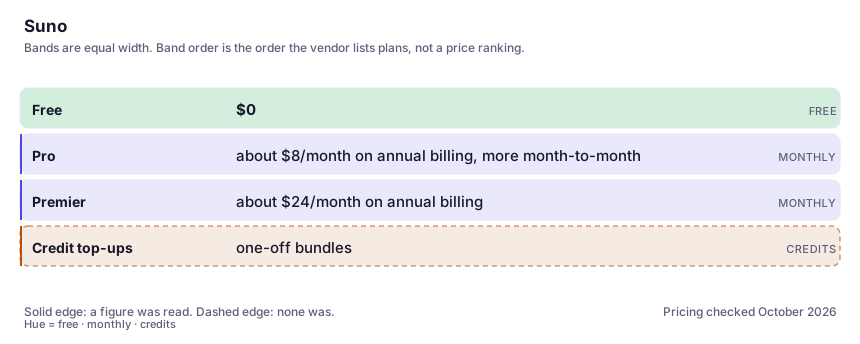
| Plan | Indicative price | What you actually get |
|---|---|---|
| Free | $0 | A small daily credit allowance, no commercial rights and limited downloading. Perfect for a week of experimenting; wrong for anything a client pays for. |
| Pro | about $8/month on annual billing, more month-to-month | A few thousand credits a month, commercial use rights, song downloads and stem access. The tier a hobbyist or a video editor needs. |
| Premier | about $24/month on annual billing | Roughly 10,000 credits a month plus the same commercial rights. Worth it only if you generate heavily and throw most of it away — which is the normal workflow. |
| Credit top-ups | one-off bundles | Available when you spike. Do not rely on them for a client deadline: a paid plan's monthly pool is the sane way to work. |
Who it fits, and who it doesn't
Reach for Suno if you…
- Songwriters who need a fast demo of a hook and intend to re-record it properly.
- Video creators wanting a short sting or bed where a stock library search would take longer than the generation.
- Parodies, internal events and one-off jokes where the point is the lyric and nobody is monetising it.
- Anyone testing whether an idea is worth hiring a human for.
Skip it if you…
- You intend to release it as your own music on a store or into licensing deals — the paperwork will not hold.
- You need a specific melody, arrangement or performance; this is not that instrument.
- You are commercial on the free tier, which breaches the terms you agreed to.
- Your client wants a track that sounds like a named artist. That is the version of this that gets you sued.
How to test it properly in 30 minutes
Don't judge a tool on the demo. Run the same four tasks you'd actually do with it, and score it against this checklist — the same one this desk works from before a profile goes up (see how we check a tool).
- Generate three songs: one prompt-only, one with your own lyrics, one with a described style. Compare how much you keep and how many credits it cost.
- Listen for intelligibility: can you make out every word in the chorus without reading the lyric panel? If not, the output isn't ready for a paid campaign.
- Read the current terms for your plan on commercial use, downloads and ownership, and screenshot what you relied on before a client deliverable.
- Run one of your favourite tracks through a content-ID or distribution test and see whether anything trips.
- Extend a clip twice and judge whether quality held. If it fell apart, plan for shorter songs and more generations.
Alternatives worth comparing
The voice tool for narrators, dubbing and game audio — best-in-class TTS, provided you respect the consent rules.
Descript
Edit video and podcast by editing the transcript — the fastest way for a writer to cut sound.
The hub where open models, datasets and demos live — infrastructure for builders and researchers, not a consumer chatbot.
Disclosure: this profile is editorial. Suno did not review it, pay for it or provide a free account for it. Links to the vendor are plain outbound links, not affiliate links. Errors are mine — report one and it gets fixed and logged on the updates page.