ElevenLabs
The short verdict
The best synthetic voices you can buy, and the tool most likely to get you into an argument about consent if you clone carelessly. Pay for the tier your character count actually needs, and never build a product on the free licence. If you only read the odd sentence aloud, the voices already in your software are good enough.
- Maker
- ElevenLabs
- Category
- Audio
- Entry price
- Freemium
- Free option
- Yes — a monthly credit allowance, non-commercial with attribution
- Works on
- Web, API, iOS, Windows desktop, browser
- Pricing checked
- October 2026
What ElevenLabs is, plainly
ElevenLabs turns text into speech that people no longer instantly identify as a robot, which is why it ended up in audiobooks, explainer videos, dubbing pipelines, game dialogue and IVR systems. One account covers several jobs that used to need separate vendors: text to speech, speech to text, sound effects, voice design, a music sketcher, and a browser studio where you can arrange clips on a timeline. For most people the decision is not "is it good" — it is whether the credit math and the consent rules fit how you work.
The thing that decides that is how credits are spent. Generations are billed per character on the standard multilingual models, and you pay for every take you keep and every take you throw away. Long scripts get split into chunks, so a paragraph you regenerate four times to fix one mispronounced brand name costs four times. Add in the fact that the output that sounds flawless on a single sentence often degrades over three paragraphs — pacing drifts, the voice tightens on sibilants, an acronym gets read as a word — and a cheap-looking monthly plan can be consumed in a week of real audiobook work.
Voice cloning is where honesty matters most. Instant Voice Cloning needs a small amount of reference audio and produces a usable likeness alarmingly fast; Professional Voice Cloning wants a much longer clean sample and sits behind a higher tier. The vendor asks for consent from the voice's owner, but that is a policy, not a lock — and a policy does not protect you from a person who did not consent, from union and personality-rights claims, or from a platform that takes the clip down later. If you are cloning anyone other than yourself, get written permission that says what it covers, how long it lasts and whether derivatives are allowed. If you are publishing commercially, read the current licence terms for your specific plan rather than trusting anyone's summary of them, including this one.
It is also not the only option. Built-in and cloud voices from the big platform vendors have improved enough for flat narration in training videos and product demos, and Descript will fix a single flubbed line inside your edit without a separate tool. ElevenLabs earns its place when the voice has to carry the piece: long-form listening, character work, or a client who will notice.
Where it wins
- Still the reference point for natural synthetic speech; the gap over cheaper cloud voices is obvious within a sentence.
- One subscription covers narration, transcription, effects, dubbing and simple arrangement, so small teams avoid a stack.
- Character-level credit accounting is at least predictable — you can count a script and know the cost before you generate.
- Cloned-voice quality from a modest sample is genuinely good, which makes self-cloning (with your own consent) a real productivity tool.
- API is simple enough that a non-specialist can automate a batch of narration files in an afternoon.
Where it falls short
- You pay for discarded takes; long-form work quietly multiplies cost once you start chasing one bad word.
- Quality over a sentence does not predict quality over a chapter — drift, pacing and mispronunciation appear at length.
- Cloning consent is a policy with weak enforcement, which puts the legal risk on you, the person pressing generate.
- Free-tier terms are non-commercial with attribution, so the trial you use to validate a business idea is not the licence you ship under.
- Credit allowances across models and features are not equivalent; a music or effects generation burns what a page of speech would not.
- The studio timeline is thin next to a real DAW, so most serious editors export audio and finish elsewhere.
What it's built for
Text to speech with several quality/speed tiers
Choose per request between a fast low-latency model and the slower, more natural ones. The fast model is fine for internal walkthroughs and noticeably worse on names, numbers and anything emotional — test the exact model, not just the product.
Instant and Professional Voice Cloning
Instant cloning works from a short sample and is the feature that gives the company its reputation and its legal exposure. Professional cloning needs a long, clean, properly-licensed recording and is gated to a higher plan. Both expect the subject's consent; enforcement of that expectation is thinner than most users assume.
A library of licensed stock voices
Voices contributed by actors are available to use inside the product, which is the cleanest path when you need a specific accent or age and don't want to source a performer yourself. Check the licence attached to the individual voice, not just your subscription tier, and keep a record of which voice you used.
Pronunciation rules and project organisation
You can pin how a name, acronym or product word is spoken instead of re-prompting forever. This is the single highest-value setup task: build one ruleset for your brand and reuse it, or you will spend your allowance on retakes.
Sound effects, dubbing and an API
Text-to-effect generation, multilingual dubbing and a straightforward API mean the same account covers a game prototype, a localised course and a batch job. Dubbing output still needs a bilingual human to check meaning, timing and whether names got mangled.
What it costs, and what these numbers cannot tell you
| Plan | Indicative price | What you actually get |
|---|---|---|
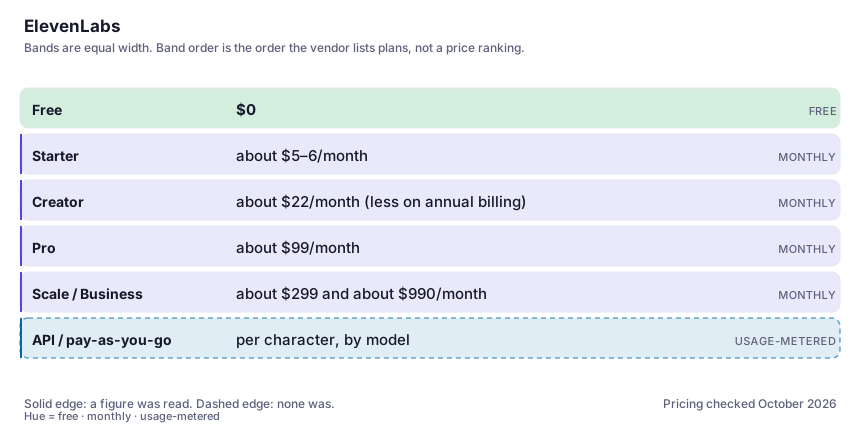
| Free | $0 | Roughly 10,000 credits a month, no voice cloning, and a licence that is non-commercial with attribution. Enough credits to check one script; not enough to ship a series. |
| Starter | about $5–6/month | Around 30,000 credits and Instant Voice Cloning. The cheapest point at which commercial use is allowed, which is why most solo creators start here and outgrow it. |
| Creator | about $22/month (less on annual billing) | Around 121,000 credits, Professional Voice Cloning and a broader personal-use licence. The tier a narrating podcaster actually needs. |
| Pro | about $99/month | Roughly 600,000 credits plus higher-quality audio formats. Only for long-form and volume; buy it after you have measured a real project's character count, not before. |
| Scale / Business | about $299 and about $990/month | Millions of credits, more seats, API capacity and business terms. The relevant question is whether you need the team and contract layer, not the voices. |
| API / pay-as-you-go | per character, by model | Rates differ by model tier and change often. Price your script in characters before choosing a plan — the pricing page is the only trustworthy source here. |
Who it fits, and who it doesn't
Reach for ElevenLabs if you…
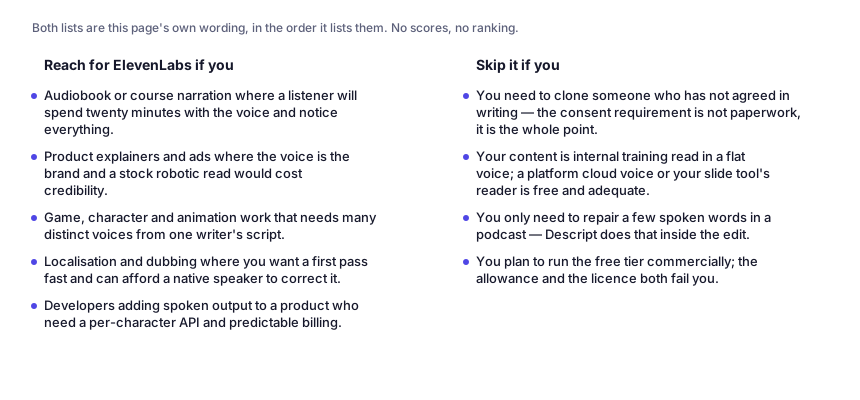
- Audiobook or course narration where a listener will spend twenty minutes with the voice and notice everything.
- Product explainers and ads where the voice is the brand and a stock robotic read would cost credibility.
- Game, character and animation work that needs many distinct voices from one writer's script.
- Localisation and dubbing where you want a first pass fast and can afford a native speaker to correct it.
- Developers adding spoken output to a product who need a per-character API and predictable billing.
Skip it if you…
- You need to clone someone who has not agreed in writing — the consent requirement is not paperwork, it is the whole point.
- Your content is internal training read in a flat voice; a platform cloud voice or your slide tool's reader is free and adequate.
- You only need to repair a few spoken words in a podcast — Descript does that inside the edit.
- You plan to run the free tier commercially; the allowance and the licence both fail you.
Where it stops fitting
How to test it properly in 30 minutes
Don't judge a tool on the demo. Run the same four tasks you'd actually do with it, and score it against this checklist — the same one this desk works from before a profile goes up (see how we check a tool).
- Generate 500 words of your real script containing three proper nouns, two numbers, one acronym and one long quote. Count the corrections before you judge the voice as good.
- Render one full chapter rather than a demo sentence and listen at the end for drift in pace and tone.
- Read the licence attached to the plan you'd buy and to the specific stock voice you picked, and note whether commercial use, redistribution and AI-training rights are all granted.
- If you intend to clone: produce the consent document first, then test whether the clone is convincing to someone who knows the speaker.
- Count characters in your typical month of work and map it to the tiers above. Buy the tier your volume needs, not the one the landing page pushes.
Questions people ask
Can I clone anyone's voice?
Technically the tool will let you try; legally and ethically that is a different question. Cloning a real person without their permission risks personality-rights and publicity claims, breaches platform rules, and can end a distribution deal. The safe workflow is written consent that names the intended use, the duration, and whether you may make derivative content — and using the contributor voice library instead when you just need a good voice rather than a specific one.
Does my subscription let me sell what I generate?
Paid tiers generally grant commercial use of your generations, while the free tier is commonly non-commercial with attribution. But your plan is only half the licence: the voice you used, the model that produced it and the platform you publish on each add terms. Check all four before a client pays you, and keep the evidence.
Why did my credits vanish so fast?
Because generations are charged whether you keep them or not, long scripts are processed in chunks, and the premium or feature-specific models cost more per unit than the standard speech model. Measure your script in characters, fix pronunciation with rules instead of retakes, and pick the cheapest model that passes your listening test.
Is it better than the free voices already in my software?
For a sentence read aloud by an operating system, no — the gap has narrowed. For twenty minutes of listening, an emotional read, a consistent character, or a clone of your own voice, the difference is still obvious to ordinary listeners.
Alternatives worth comparing
Descript
Edit video and podcast by editing the transcript — the fastest way for a writer to cut sound.
Suno
Songs with vocals from a text prompt — unbeatable for sketches and jingles, still a legal grey zone for releases.
The hub where open models, datasets and demos live — infrastructure for builders and researchers, not a consumer chatbot.
Disclosure: this profile is editorial. ElevenLabs did not review it, pay for it or provide a free account for it. Links to the vendor are plain outbound links, not affiliate links. Errors are mine — report one and it gets fixed and logged on the updates page.