DeepSeek
The short verdict
Use the free chat app as a thinking tool and nothing more — it is plain, it is free, and it will not hold your work together. Take the API seriously if your job is volume text work and you can watch peak hours; take the open weights seriously if your job is sensitive data. Nobody should pay DeepSeek for a consumer subscription, because there is not one to pay, and that absence tells you exactly which customer the company is building for.
Changes that touch this profile
The news desk logged these changes and dated them. Each line links to the item that recorded it.
- Maker
- DeepSeek (Hangzhou DeepSeek Artificial Intelligence)
- Category
- Chat assistants
- Entry price
- Free chat; pay-as-you-go API
- Free option
- Yes, and it is the whole consumer product: the web chat and both mobile apps are free, and DeepSeek publishes no consumer paid plan on its own pages
- Works on
- Web chat, iOS, Android; API compatible with both OpenAI and Anthropic formats; open weights on Hugging Face; DeepSeek Harness in developer preview
- Pricing checked
- October 2026
What DeepSeek is, plainly
DeepSeek is really two things that get mistaken for one. The first is a free chat product: a web page at chat.deepseek.com and iOS and Android apps, run by Hangzhou DeepSeek Artificial Intelligence Co., Ltd, a research lab that grew out of the quant fund High Flyer. The second is a family of models the company publishes openly and sells API access to, which is where its reputation and its money are. The chat app is the thinner of the two by design. Its homepage offers a text box with two toggles — deep reasoning and intelligent search — and the app listing gets to the point in a sentence: the official assistant, for free, powered by the latest flagship model, which as of 10 September 2026 is DeepSeek-V4.1-Flash with native image understanding. There are no projects, no workspace, no add-on storefront, no memory panel worth the name. What you get is a cheap front door onto a research model, and its documented strengths are maths, code and plain step-by-step explanation. The vendor publishes no prose comparison, so the gap to the leading Western assistants on prose that needs a voice is what its users report, not something measured here.
Where it loses is the product, not the weights. Against ChatGPT or Gemini it has no ecosystem: no connectors into your files, no shared team spaces, no polished mobile features, and the two app stores reflect that with ratings hovering around 3.8 on both rather than the 4.7 to 4.9 the incumbents hold. The free client also inherits its parent's priorities — the model behind the button changes without announcement, and the API docs say the older model names are still accepted but now quietly served by V4.1-Flash at the Flash price. Two more concrete gaps for anyone treating this as a work tool: the chat product has no paid tier, which means no support channel and no service promise, and the API's stronger model, deepseek-v4-pro, does not accept images at all while the cheap flash model does. And the clearest signal about capacity pressure is the pricing page itself, which bills off-peak at exactly half the peak rate during stated Chinese daytime hours — you are being price-discriminated away from the busy periods.
The commercial shape is refreshingly boring, which is the point. The consumer chat costs nothing and DeepSeek sells no membership, so there is no renewal to forget. The API is prepaid: you top up a balance and token charges deduct from it, with granted balance spent first, so the failure mode is a stopped request rather than an invoice. Prices are published per million tokens and I read them from the vendor's own pricing table on 7 October 2026: for deepseek-flash, cached input is $0.003 off-peak and $0.006 at peak, uncached input $0.15 and $0.30, output $0.60 and $1.20; for deepseek-v4-pro, $0.022 and $0.044 cached, $0.66 and $1.32 uncached, $1.98 and $3.96 output. Context is 1M tokens with up to 384K of output, and a single long reasoning run against a big file can therefore cost real money even at these rates — that, plus peak hours, is where a surprise lives. The third option is the one the open weights imply: run the model yourself, which moves the cost to infrastructure you control. If you want the wider picture on stacking tools like this, the personal AI stack guide covers it.
Where it wins
- Token prices are the lowest in the mainstream tier by a wide margin, and the per-million table is published plainly with a documented caching discount.
- The weights are open, so the API is one option rather than the only one — no hostage-taking if the pricing changes.
- No consumer subscription means no accidental renewal, and prepaid billing means no surprise invoice.
- Off-peak pricing at half the peak rate is a real, usable lever for batch jobs that can wait.
- Both OpenAI and Anthropic API formats, which makes it the cheapest way to experiment inside existing agent tooling.
- Release cadence is documented in a public change log, so you can see what actually shipped and when instead of trusting a press release.
Where it falls short
- The chat product is bare and the free client is not the priority. There is no paid tier, so there is no support path, no SLA and no way to buy your way to the front of the queue.
- Model routing under the button is opaque: retired model names are still accepted but served by a different model at a different price, which is fine for chat and dangerous for anything you have tuned prompts against.
- Store ratings around 3.8 on both platforms, against 4.7-plus for the incumbents, are consistent with the complaints about capacity errors and throttling in peak windows.
- The stronger v4-pro model takes no image input, so multimodal work means using the cheaper model or a different vendor entirely.
- Data handling sits in a Chinese jurisdiction with no consumer-facing explanation on the vendor site, and the Play listing's own data-safety panel reports collection of location and personal information plus sharing of device identifiers with third parties. If you paste anything confidential, assume you have read nothing about retention.
- Peak-hour windows are defined around Chinese working time, which is a poor fit for European or American daytime batch runs — you pay peak rates exactly when your colleagues are awake.
What it's built for
A free chat app with two modes
Standard answering plus a switchable deep reasoning mode and a web search toggle, in a browser page and in iOS and Android apps. That is close to the complete feature list, and the simplicity is why some people keep it installed.
Switchable thinking on the API
The flash model supports both non-thinking and thinking modes, so you can pay for reasoning per request instead of picking a separate model. Useful when most calls are routine and a few need depth.
One million tokens of context
The published context length is 1M with maximum output up to 384K, which is enough to hold a whole codebase or a long contract in one pass. Concurrency caps differ sharply by model — 2500 on flash, 500 on v4-pro.
OpenAI- and Anthropic-compatible endpoints
Two base URLs, one OpenAI-format and one Anthropic-format, so Claude Code, Codex, OpenCode and most agent harnesses can use DeepSeek as their backend with a config change rather than a rewrite.
Open weights you can actually download
V4.1-Flash, V4-Pro, V4-Flash, their base variants, V3.2 and OCR models are all published on Hugging Face. Nothing about the API is a prerequisite for using the research, and you can audit or fine-tune locally.
Vision on the cheap model, not the strong one
V4.1-Flash has native multimodal image understanding; the v4-pro row on the pricing page states vision is not supported. If your work is screenshot-heavy, the cheaper model is the only door.
What it costs, and what these numbers cannot tell you
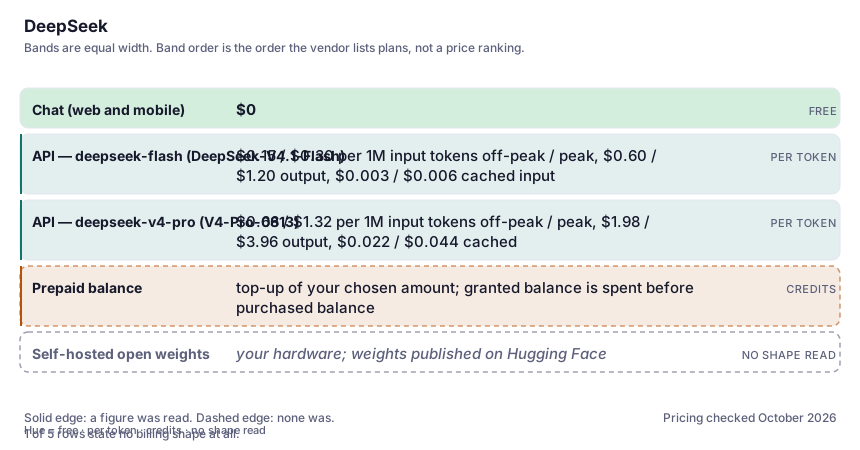
| Plan | Indicative price | What you actually get |
|---|---|---|
| Chat (web and mobile) | $0 | The entire consumer offering. No subscription, no membership, no priority queue. Whatever message caps exist are shown in the app rather than on a public page, so measure them yourself before relying on it. |
| API — deepseek-flash (DeepSeek-V4.1-Flash) | $0.15 / $0.30 per 1M input tokens off-peak / peak, $0.60 / $1.20 output, $0.003 / $0.006 cached input | The workhorse: 1M context, vision, tool calls, JSON output, switchable thinking, 2500 concurrency. Off-peak is exactly half price during the hours DeepSeek defines as peak, which are weekday windows in Chinese time. |
| API — deepseek-v4-pro (V4-Pro-0813) | $0.66 / $1.32 per 1M input tokens off-peak / peak, $1.98 / $3.96 output, $0.022 / $0.044 cached | The heavier reasoning and agent model, no vision, 500 concurrency. Fine, structured outputs, tool calls and FIM in beta are listed as supported. |
| Prepaid balance | top-up of your chosen amount; granted balance is spent before purchased balance | There is no invoice to overshoot: charges deduct from the balance and requests fail when it runs out. Convenient for cost control, annoying mid-job, and the balance does not warn you politely. |
| Self-hosted open weights | your hardware; weights published on Hugging Face | The fourth path and the reason data-sensitive teams shortlist DeepSeek at all: run the model on machines you own, with no request ever leaving your network. Verification, licence terms and GPU sizing are your problem, and honestly someone's spreadsheet. |
Who it fits, and who it doesn't
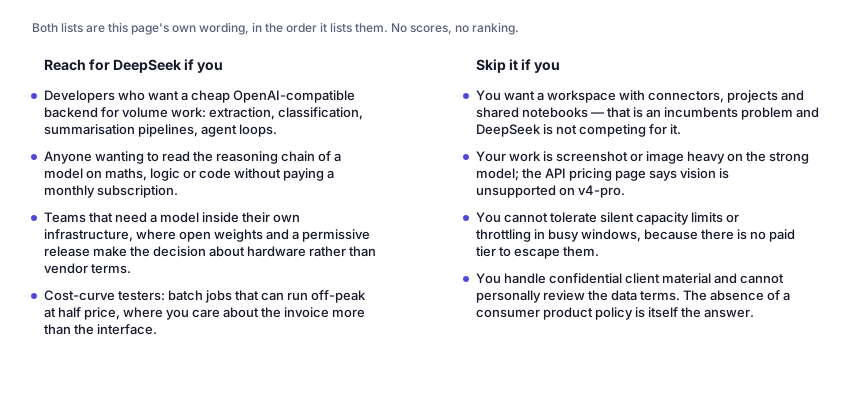
Reach for DeepSeek if you…
- Developers who want a cheap OpenAI-compatible backend for volume work: extraction, classification, summarisation pipelines, agent loops.
- Anyone wanting to read the reasoning chain of a model on maths, logic or code without paying a monthly subscription.
- Teams that need a model inside their own infrastructure, where open weights and a permissive release make the decision about hardware rather than vendor terms.
- Cost-curve testers: batch jobs that can run off-peak at half price, where you care about the invoice more than the interface.
Skip it if you…
- You want a workspace with connectors, projects and shared notebooks — that is an incumbents problem and DeepSeek is not competing for it.
- Your work is screenshot or image heavy on the strong model; the API pricing page says vision is unsupported on v4-pro.
- You cannot tolerate silent capacity limits or throttling in busy windows, because there is no paid tier to escape them.
- You handle confidential client material and cannot personally review the data terms. The absence of a consumer product policy is itself the answer.
Where it stops fitting
How to test it properly in 30 minutes
Don't judge a tool on the demo. Run the same four tasks you'd actually do with it, and score it against this checklist — the same one this desk works from before a profile goes up (see how we check a tool).
- Send the chat product one real task you do weekly and one deliberately ambiguous one. Judge whether the plain interface helps or just leaves you re-prompting.
- Run the identical prompt in thinking and non-thinking modes on the API and compare both quality and wall-clock time. The mode switch is a cost decision, not a personality setting.
- Price one job against the published table yourself: count input and output tokens, apply the peak rate, and only then decide whether off-peak scheduling is worth the engineering.
- Test caching with a repeated system prompt across many calls; the cached-input rate is an order of magnitude below the uncached one, so this single habit can dominate your bill.
- Ask a question that needs an image. Confirm which model you get, and note that the answer changes depending on which endpoint you chose.
- Read the Play data-safety panel and the terms on the vendor site before putting anything sensitive into the free chat, and decide what you would be uncomfortable pasting into any model at all.
Questions people ask
Is DeepSeek free?
The chat product — web plus both mobile apps — is free, and the vendor's own pages list no consumer subscription. What is not free is the API, which is prepaid and metered per million tokens, with rates published on its pricing page. So the honest answer is: the assistant is free, the model costs money, and if you want priority or support there is nothing to buy.
Which model does the chat app use?
The listing says the latest flagship model, and the current release in the vendor's change log is DeepSeek-V4.1-Flash, dated 10 September 2026. Treat that as a moving target: the API docs already show retired model names being served by a newer model at a different price, so the thing behind the button is a decision DeepSeek makes for you.
Is it safe to put work documents in the free chat?
I am not going to tell you it is fine. There is no consumer data policy written in English on the vendor site that I could find, the store listing's own data-safety panel reports collection of location and personal information and sharing of device identifiers with third parties, and the operating company is Chinese-incorporated. If the material matters, use the self-hosted open weights or a vendor whose retention terms you have personally read.
How does the API pricing work?
Per million tokens, with three separate rates: cached input, uncached input and output. Each has an off-peak and a peak price, and off-peak is exactly half of peak. Peak hours are defined in Chinese working windows, weekdays, excluding Chinese public holidays, so weekends and evenings elsewhere count as off-peak for them, not necessarily for you. Billing deducts from a prepaid balance and requests stop when it is empty.
Should I use DeepSeek instead of paying for ChatGPT or Claude?
If your work is high-volume and text-shaped, the API can beat a subscription on price per task by a wide margin, and you keep the option of self-hosting because the weights are open. If your work is conversational — a long document, a tone you have to hold, an email you will actually send — the assistants with real products save you editing time, and that is a cost too. See how to evaluate an AI tool for the structure this desk works from before a paid tier is described.
Alternatives worth comparing
The default AI assistant — the broadest feature set, and the benchmark every other tool gets measured against.
Claude
The assistant for people who read a lot: long documents, careful prose, and fewer invented answers.
The assistant that already has your email, docs and calendar — if you live in Google Workspace.
The hub where open models, datasets and demos live — infrastructure for builders and researchers, not a consumer chatbot.
Disclosure: this profile is editorial. DeepSeek did not review it, pay for it or provide a free account for it. Links to the vendor are plain outbound links, not affiliate links. Errors are mine — report one and it gets fixed and logged on the updates page.